

The escalation of the war in the Middle East is dominating the news, and investors are increasingly worried about the impact of this conflict on the stock market.
There are three key considerations to keep in mind:
- No one knows how long this conflict will last, or the extent to which it may evolve.
- Disruptions to the energy market —whether it be production, distribution, or general flow— could significantly impact oil prices.
- The possibility of a prolonged military conflict or higher energy prices, when consumer confidence is already weak, would increase the probability of an economic recession.
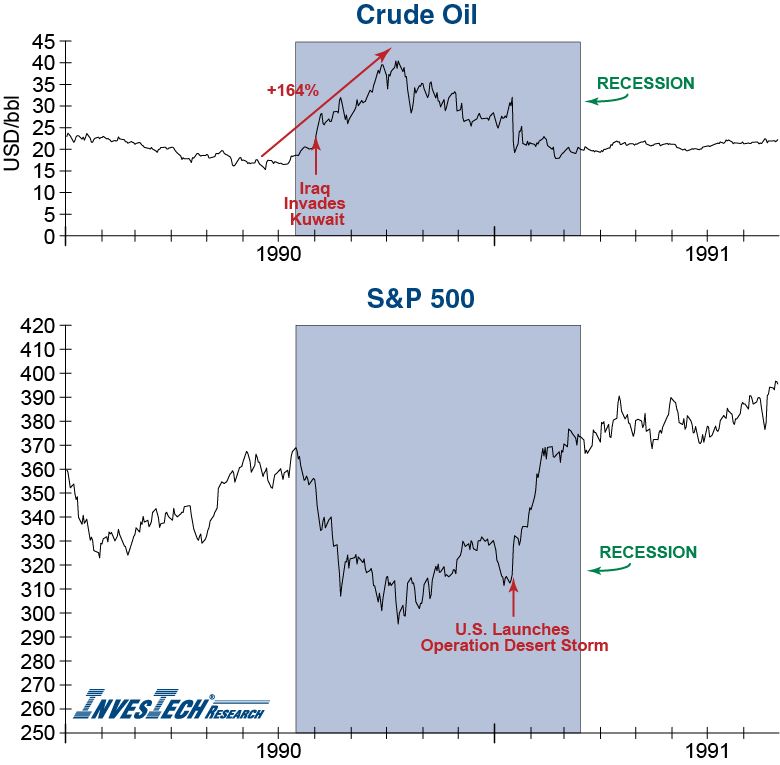
The worst-case scenario for the U.S. economy, which at this point should not be ruled out, is if the conflict widens and intensifies in a way that suspends oil production and shipments, sending oil prices significantly higher (>50%). This can almost single handedly drag down the broad economy, as was the case in the 1990 Oil Shock.
The 1990 Oil Shock
When Iraq invaded Kuwait in August 1990, oil prices shot upward over +150% helping to trigger the 1990 U.S. recession. It wasn’t until oil prices moderated and the U.S. launched Operation Desert Storm that the economy was able to climb out of the recession.
A Longer Term View
Trying to anticipate and invest for a worst-case scenario has historically been an ineffective strategy. Yet proactively managing risk and adapting one’s portfolio as evidence unfolds has a solid track record for navigating many different periods of uncertainty.
We’ve compiled this table of examples of military conflicts to provide some historical context for market reactions. This table lists important military confrontations and showdowns that have occurred since 1940, and it also looks at the market performance that followed.
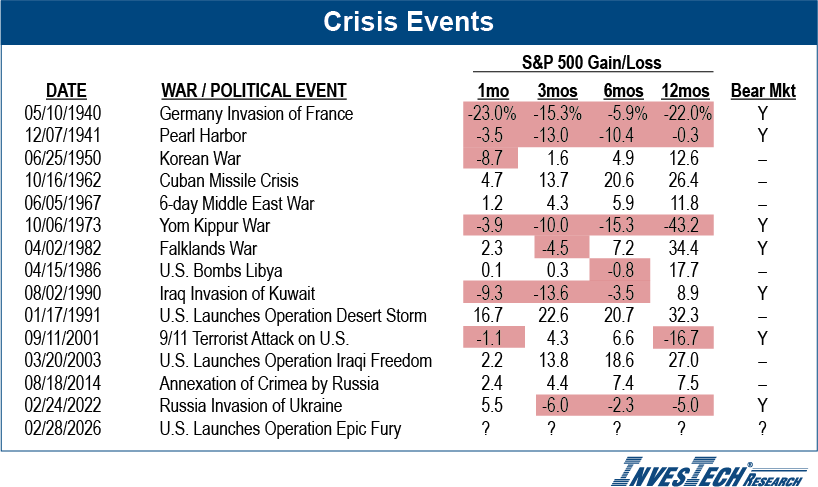
Historically, in most cases these crisis situations have typically had a transient impact on Wall Street. And the majority of the time, the S&P 500 saw gains over the next 12 months. The exceptions were 1940, 1941, 1973, 2001, and 2022 when a bear market was already in progress when the conflicts began. While any significant military action can be scary, geopolitical disputes do not make or break the market. Ultimately, the first rule for investing through regional conflicts is “don’t overreact.”
Accordingly, the crisis does not change our strategy at this time as InvesTech’s Model Fund Portfolio continues to exhibit strength in this volatile start to the year. Going forward, however, it remains essential to keep a close eye on technical and macroeconomic warning flags and make necessary adjustments based on the changes in the weight of the evidence.