
Space is absolutely fascinating, and SpaceX is working on very interesting and exciting projects – no one can deny that. However, the financials of its IPO are far from favorable with an estimated price-to-revenue ratio of 94 (Nvidia currently sits around 20), and historical precedent warns us that mega IPOs are rarely safe profit opportunities.
As the SpaceX debut continues to dominate the financial news, we’ve decided to publish a segment of the June newsletter early so you can approach the SpaceX IPO from an informed perspective.
InvesTech Research – June 19, 2026:
Aside from being the largest IPO ever, SpaceX has a few important things that really set it apart:
- The majority of IPOs go public with 10-40% public float. This means that if a company is valued at $1 billion, they would raise $100-$400 million in their IPO. In contrast, SpaceX is looking at an approximate 4% public float. While everyone is talking about the value of SpaceX at $1.8 trillion, only $75 billion will be raised in the IPO. A small public float often artificially inflates the stock price and amplifies volatility. This is due to the relatively lower volume of shares exhibiting a high sensitivity to supply and demand.
- The primary reason that companies went public in the past was to raise capital to fund research and development, expand operations, and pay down debt. But with SpaceX setting a lofty IPO valuation and selling only 4% of shares, one has to question whether the primary reason for going public isn’t to provide liquidity for private investors and internal owners to sell their shares to the public for a huge payday.
Mega-IPOs typically grab investors’ attention; however, they frequently experience significant volatility and often end up below their initial price – even a year after going public (table below). Of the 8 largest IPOs that are more than a year old, 6 experienced significant losses and closed their first year well below their offer price.
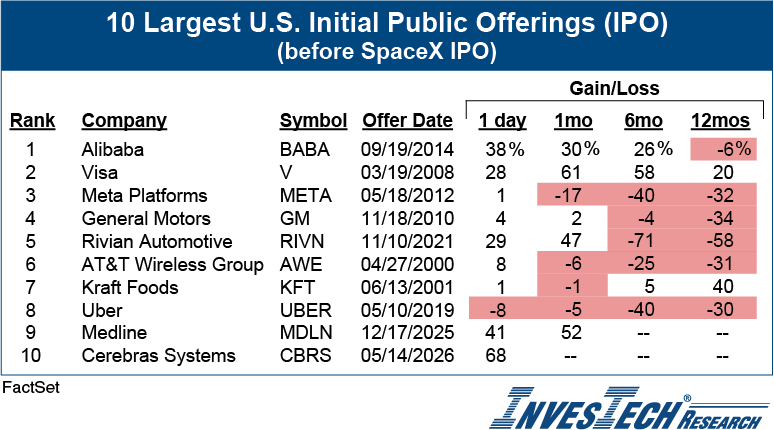
While IPOs regularly experience breathtaking volatility, and often losses, the risks had typically been contained to institutional investors or passionate retail traders. The way IPOs impact everyday investors is rapidly changing as various index creators have adjusted their requirements to allow mega-IPOs to join…
FTSE Russell Latest to Make U.S. Index Inclusion Easier Ahead of SpaceX IPO – Wall Street Journal, 5/27/2026
SpaceX IPO could hit popular index funds – and your 401(k) – in as little as 5 trading days as indexes relax their rules – Yahoo! Finance, 6/1/2026
However, this is not the case for all market indexes.
SpaceX Must Wait a Year to Be Part of S&P 500. The Rules Won’t Change for Megacap Companies – Barron’s, 6/4/2026
No one accidentally bought Rivian days after its IPO, but the same won’t be able to be said about SpaceX. Index inclusion requirements are convoluted and complicated so don’t make overarching investment decisions based on headlines popping across your screen. It would be prudent, however, to keep an eye on any index funds you might own so you don’t unknowingly become a SpaceX speculator. Bottom line, tread carefully – it’s getting nutty out there.
Based on past experience with overhyped IPOs, a dramatic pop in the opening days of trading is not out of the question. However, that does not mean that the SpaceX IPO will not suffer the same fate of other mega-IPOs or that this is a safe “can’t-lose” investment opportunity.